
Direct answer
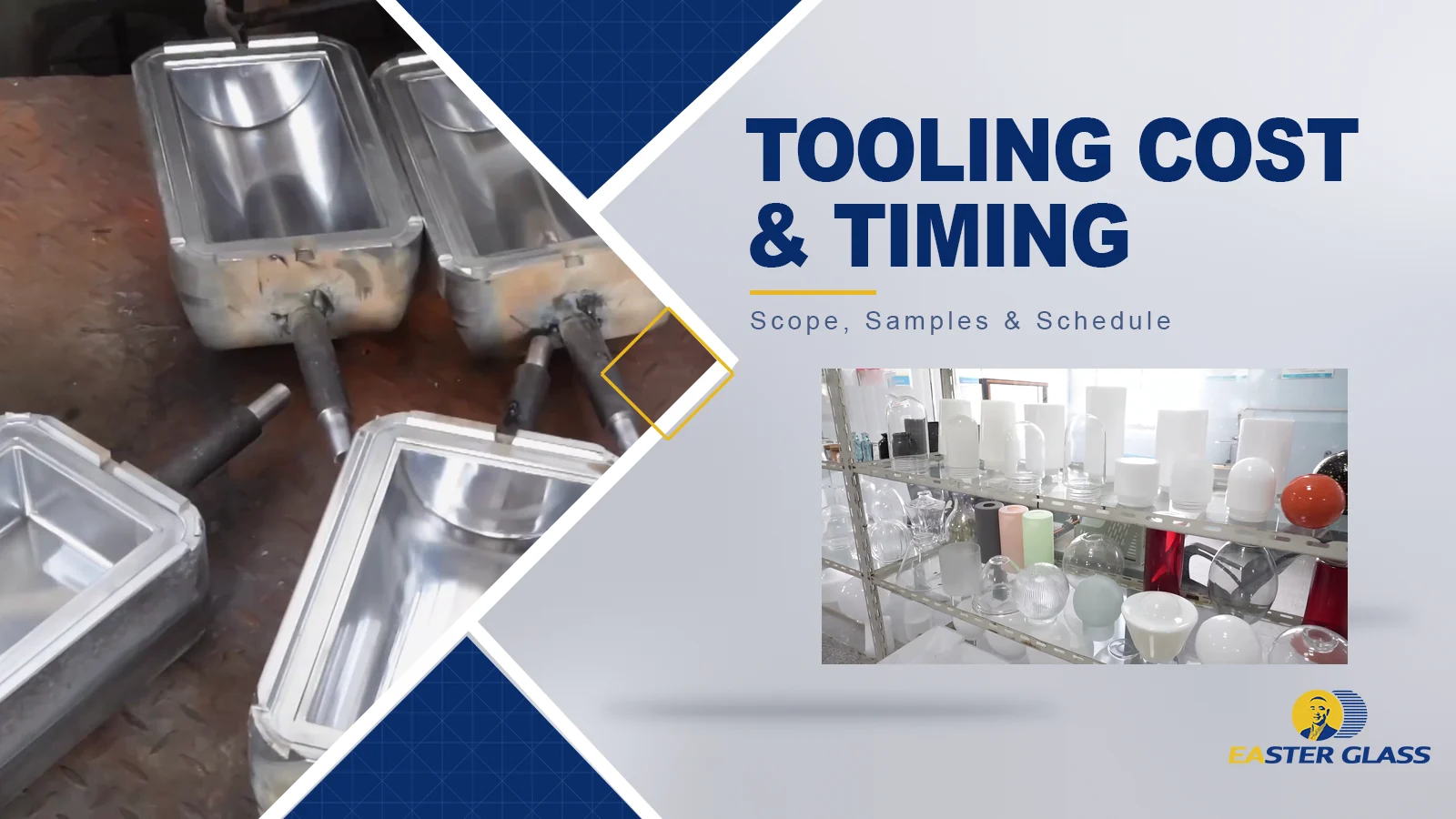
The main factors affecting custom glass tooling cost and development timing are the agreed geometry, forming route, condition and fit of any reusable tool, finish and inspection scope, and unresolved sample reviews or design changes. A useful quote separates engineering, tooling, samples, production and delivery, then states its assumptions, quantity basis and schedule start event.
What should tooling cost cover in a custom glass quote?
Tooling is the project-specific equipment or tool work needed to form or finish a defined glass component. A quotation should identify whether it covers a new tool, a modification to an existing tool, use of an available tool, or a combination of engineering and trial work. The word “mold” by itself does not say what is included, who pays for each item, or what rights apply to later use.
Treat the tooling amount as a scoped line, separate from the glass unit price and from sample, inspection, packaging or freight charges. One supplier may quote a single combined development amount; another may split design review, tool fabrication, adjustment and sample runs. Those formats can both be evaluated if the scope and assumptions are visible. A low initial figure is difficult to compare when an unlisted operation appears in a later revision.
Ask which part number and revision, variants, tool, included sample work and exclusions the amount covers. For an existing or reusable tool, name the geometry and revision it fits; availability alone does not prove compatibility with a changed diameter, seat, pattern, material or finish.
Record whether the charge covers engineering, a physical tool, modification or trial work. Clarify ownership, storage, permitted parts and later maintenance or change charges. Product pages and sample approvals do not establish these contract rights.
| Quote line | What it may cover | What changes the scope | Ask the supplier to state |
|---|---|---|---|
| Engineering review | Review of the part definition, interfaces and open requirements | Incomplete drawings, competing references or unresolved process assumptions | Included review work and the revision reviewed |
| Tool design or preparation | Definition of the tool scope for the agreed product | New geometry, surface relief, part variants or an unclear reference tool | Whether design work is included or separately charged |
| New tool or tool modification | Fabrication or alteration of the tool required for the part | Geometry, material, forming route, tool condition and changes after design release | New, modified, existing or shared basis; price and ownership terms |
| Sample or trial work | Making and reviewing development samples | Number of review rounds, sample quantity, finish scope and inspection | Included sample rounds, included operations and additional-round basis |
| Finishing and inspection | Operations or checks after forming | Treated area, optical or appearance criteria, critical dimensions and special tests | Which operations and records are included in the sample and production prices |
| Packaging and delivery | Protection and shipment of samples or production parts | Sample fragility, presentation, destination and shipping method | Whether packing, freight, duty and insurance are included or excluded |
The table helps buyers compare proposals on one basis, not predict a glass tool price. NIST’s supplier-scouting request form illustrates a structured request that collects process, dimensions, tolerances, material, volume, delivery, packaging and supporting files. It is a U.S. program example, not a glass pricing rule.
Which product features change the tooling review?
A tooling discussion begins with the finished component, its intended function and the assembly around it. The same product noun can hide different tool questions. A “glass lens” could refer to a smooth dome, a raised grid pattern, concentric steps or a specific seating rim. A “lamp shade” could have a straight tube, a shoulder, a threaded interface or a flared opening. Those features must be distinguished before a quote can name its scope.
Geometry, relief and optical surfaces
Describe the surfaces that the tool must reproduce and separate them from appearance that comes from a later finish. A repeating grid molded into the glass, a frosted area added after forming and a printed graphic are different requirements. Show the location and orientation of each one. If an optical surface is functional, identify which view or specification defines its profile and which fixture-level result must be reviewed separately.
The clear grid pattern borosilicate glass lens with a raised grid face has a repeating raised pattern and perimeter seating rim. The frosted borosilicate Fresnel glass lens with concentric stepped rings shows another surface structure. These product examples do not establish shared tooling or optical acceptance criteria. Confirm the current drawing, profile, seat and inspection basis for the quoted part.
A peer-reviewed review of glass-pressing simulations discusses glass flow, heat transfer and residual stress together. It supports reviewing material, mould and process as a connected engineering question, but does not predict a project price or schedule. Ask which quoted operation and sample check cover each surface feature.
Mounting seats, openings and mating hardware
A seating shoulder, neck, thread, groove, flange or opening can affect both the tool definition and the time needed to verify fit. Provide an assembly section that shows where the glass rests, how it is retained, and what clearance is required. If a metal holder, retaining ring, gasket or other mating hardware controls the interface, the customer should identify it and supply a representative sample when requested. A drawing alone may not reveal actual fit if the hardware sample differs from its nominal drawing or remains under development.
The gradient-frosted borosilicate tube shade with a stepped seating end shows why the visible shade and fixture interface need separate descriptions. The borosilicate glass product range covering tube shades, domes and lighting covers contains different forms; the shared category does not establish shared tooling.
A domed optical glass lens with mounting neck and defined seating area shows how the optical surface and mechanical location can both matter. The optical glass product collection covering lighting lenses and mounting forms provides broader context. Ask which feature locates the part, which surface governs optical alignment, and what hardware sample is needed to check the assembly.
Material, forming route and finishing scope
Material and process should be stated or explicitly left open for review. A request for a pressed patterned lens is different from a request for a hollow blown shade, even when both are described as a “glass cover.” If the process is not locked, ask the supplier to quote the recommended basis and list any alternative that changes the tool, sample or inspection scope. Do not compare quotes if one assumes a forming route and another assumes a different route without making that difference visible.
A surface finish may be part of tool geometry or a separate finishing operation. State whether the requirement is molded texture, frosting, coating, printing, grinding or another finish. Mark its face, boundary and orientation, and identify any seating or sealing area that must remain clear. A finish sample may need its own approval even if the glass geometry is unchanged. Keep the finish operation and its acceptance reference as separate quote lines where that helps trace cost and timing.
The official Pressed Glass | Precision Pressing video shows a production process. Use it to understand the forming context; the clip does not establish the tool, schedule or cost for a product shown in this guide.
ISO 128-1:2020 describes technical drawings as documentation for a workpiece, subassembly or assembly. ISO 129-1:2018 covers presentation of dimensions and tolerances, while distinguishing that from tolerance application. Agree which drawing or model governs when files conflict.
| Feature or product form | Example from the product range | Quote or timing question | Reference to provide |
|---|---|---|---|
| Raised surface pattern | Clear grid pattern borosilicate glass lens | Is the pattern part of the formed profile, and how will it be checked? | Controlled profile or finish view and optical acceptance basis |
| Concentric optical relief | Frosted borosilicate Fresnel glass lens | Which profile and seating features govern the tool and sample review? | Optical drawing, mounting section and sample ID |
| Hollow tube with stepped seat | Gradient-frosted borosilicate tube lamp shade | Does the quoted geometry include the seat, openings and finish transition? | Part drawing, assembly section and mating holder or sample |
| Domed lens with mounting neck | Domed optical glass lens with mounting neck | Which surface governs optical alignment and which feature locates the lens? | Optical specification and fixture or retention interface |
| Special finish or tolerance | Frosted, printed, ground or controlled interface area | Does the finish or inspection require separate approval or work? | Finish map, limit, units, measurement condition and acceptance reference |
How do first-order quantity and product variants affect the quote?
State the first order quantity, expected repeat volume and product variants together. A quantity alone is incomplete when the program includes different sizes, finishes, interfaces or optical profiles. Identify part numbers and which variants need sample approval.
Ask for unit-price bases at the first order and repeat quantity. If tooling is amortized, request the calculation and confirm how forecast changes affect it. If charged separately, check whether samples are included. An annual forecast is not a purchase commitment unless the contract says so.
Request an MOQ for each defined configuration. Ask whether clear, frosted and printed versions share a minimum or create distinct lots by color, finish, size or interface. “Same shape” may not mean the same finished glass lamp shade when material, opening, finish boundary or seat changes. List first-order quantity and variants in the RFQ.
Related glass globes may differ in neck, size or surface pattern; lenses may share an outer rim but use different profiles. Ask which variants fit one tool scope and which require separate work.
Keep development and tool charges, sample charges, unit prices at stated quantities, and delivery-related costs visible. This lets buyers relate each price to the first order and repeat production without guessing a per-part tool cost from a combined total.
What sets the development schedule?
A development schedule should name events and dependencies, not just a duration. Separate quote response, engineering review, tool work, first sample, revisions, approval, production and shipment. Confirm the start event before comparing schedules.
Define the start event. It may be complete drawings, confirmed process/material, approved tool scope, payment or receipt of customer-supplied hardware. Record the agreed trigger in the quote because “lead time” can refer to different intervals.
Agree what happens at each milestone
A practical milestone list can include:
- Technical review complete, with open items and quotation assumptions recorded.
- Tool scope approved against the current part number, drawing revision and variant list.
- Tool fabrication or modification complete, with the next sample event identified.
- First sample available for dimensional, appearance, assembly or optical review as specified.
- Customer feedback returned against a sample ID and drawing revision.
- Required tool or product changes closed, then final sample approval recorded.
- Production slot and shipment basis confirmed against the approved configuration.
This is a planning framework, not an Easter Glass service-time promise. Ask whether milestones use working or calendar days and whether sample shipping or buyer review is included. Show fit trials, artwork approval and lighting evaluation as separate review intervals so the supplier’s work and customer dependencies remain visible.
Keep quotation turnaround, sample-development timing and production lead time separate. A quote may precede a final interface; production timing may depend on sample and specification approval. For international projects, show transit and customs separately from manufacturing milestones.
Ask where special tolerances, finish controls, inspection records and customer-supplied hardware sit in the schedule. If a “sample lead time” is quoted, check whether it includes tool work, finishing, inspection and delivery, or ends at dispatch.
How should buyers compare tooling proposals?
Compare proposals against one controlled part definition. Give every supplier the same drawing revision, model, assembly section, finish, special tolerances, mating hardware, application, first order quantity and target event. NIST’s supplier-scoping example separates technical and business information and accepts drawings and photos; it is an organizing model, not a glass quote standard.
For each proposal, state whether the tool is new, modified or proposed for reuse. The clear grid pattern borosilicate lens page labels its mold “Shareable”; the domed optical glass lens with mounting neck page marks its mold “Non-shareable.” These are item-level catalog descriptions, not guarantees of availability, compatibility, customer ownership or rights for another revision. Ask the supplier to identify the exact geometry and remaining change or check scope.
List included sample rounds and define a revision. A drawing, hardware or optical-surface change after a sample may affect several quote lines. Ask whether corrections are included in the development scope or treated as new work. Apply the same question to artwork, color, coating and packaging samples.
Identify each sample by part number and revision, and tie feedback to a feature or acceptance reference. Record appearance approval separately from any open fit or tolerance check. A “golden sample” is useful only when its governing characteristics are defined.
For a manufacturer discussion of tooling scope for raised-grid glass lighting parts, ask for the listed tool basis and how the optical pattern will be checked. For a supplier clarification of mold reuse for borosilicate tube lighting components, ask which dimensions and seating interfaces are covered. An OEM supplier review of development milestones for Fresnel glass lighting lenses should connect tooling, the first sample, optical requirements and assembly checks to named release events. Each phrase links to an owner page or project route; the product examples remain links to their individual detail pages.
When should a buyer request a revised quote?
Request a revised quote whenever the approved scope changes in a way that could affect the tool, sample, production route, inspection or delivery basis. Examples include a revised opening or seating diameter, a changed optical pattern, a new finish boundary, a tighter special tolerance, an added color variant, a different mating holder or a new first-order quantity. A title-block revision without a geometry change should still be identified, but the supplier can confirm whether it changes the quoted work.
Record the old and new revisions, changed feature, affected work, requested effective date and remaining quantity. Ask which cost lines and milestones change. Identify superseded drawings, models and finish references, plus requirements that remain unchanged.
For a revised part, confirm whether the prior tool can be modified and whether the sample plan still verifies fit and appearance. Update the hardware reference if the interface changes. A new finish can need a separate sample review even when geometry is unchanged.
For schedule changes, ask which milestone moved, why, and whether the estimate includes tool changes, customer review, inspection or shipment. Tie the new date to that milestone and keep the original quotation basis in the change record.
Frequently asked questions
Does an existing glass mold mean there is no tooling charge?
No. The words “existing,” “reusable” or “shareable” do not define the fit, condition, commercial rights or remaining work. Ask which exact part geometry and drawing revision the tool covers, what modification or trial is included, and whether any use or ownership terms apply.
Does a more detailed glass pattern always increase tooling cost?
There is no universal price rule based only on the visual description. A pattern may be part of the formed surface, a separate finish, or an optical feature with its own acceptance requirements. Identify the pattern, the forming or finishing operation being quoted and how the sample will be checked.
When does the development lead-time clock start?
The quotation should name the start event, such as drawing approval, tool-scope approval, payment or receipt of a required mating part. It should also state whether the estimate uses working or calendar days and what customer approvals or shipping intervals are excluded. Compare schedules only after confirming that their start and end milestones match.
Should the tooling charge be compared with unit price?
Compare both, but keep their bases separate. The tool charge relates to the stated tool and development scope; the unit price relates to a stated production quantity and configuration. Ask whether samples, finishing, inspection, maintenance and future tool changes are included or separately charged.
What should be included when requesting a first-order quote?
Include the latest 2D drawing and matching 3D model where needed, material and finish, application, assembly section, special tolerances, customer-supplied hardware, first order quantity and expected variants. Mark what is fixed and what remains provisional. Ask the supplier to list assumptions, MOQ, included sample rounds and the schedule trigger.
Can related glass shades or lenses share one tool?
They may or may not. Similar names or outlines do not establish identical geometry, material, seating, surface profile or tool conditions. Ask the supplier to identify the specific variants covered by one tool and any checks or modifications required for each one.
Tooling quote takeaway
A useful tooling quote ties a defined glass part to a specific tool basis, sample scope, quantity, approval sequence and schedule trigger. Review the geometry, process, surface finish, mounting hardware, special tolerances and application together. Compare separate cost lines and milestone dates, and record which file revision governs. This creates a clearer basis for supplier discussion without assuming a fixed cost or universal development time.
Discuss tooling scope for a custom lighting glass part
Share the current drawing, model and assembly section, then identify the product family, application, first order quantity, finish, special tolerances and any mating hardware sample. Easter Glass can review the defined scope and discuss the information needed for a project-specific tooling and sample proposal.
 Easter Glass. Custom glass components for commercial lighting OEM and ODM projects.
 English