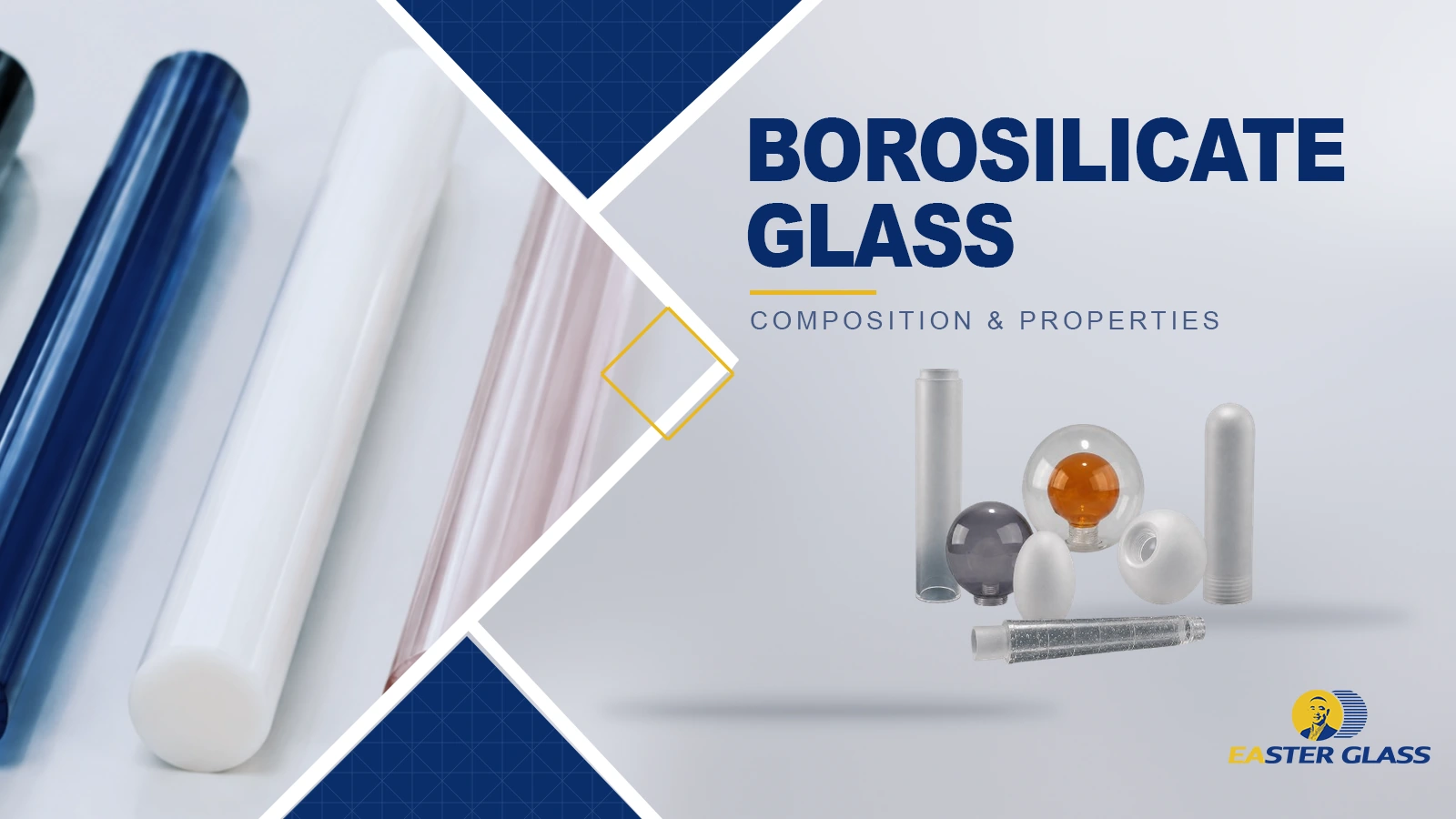
Direct answer. Borosilicate glass is a family of silicate glasses containing boron oxide; its exact composition varies by type and grade. In one published borosilicate flat-glass datasheet, the listed thermal expansion is lower than the soda-lime comparison over the stated interval. Those figures are general industry references, not Easter Glass specifications or a performance conclusion for a lighting part.
On this page
What is borosilicate glass?
Borosilicate glass is not one universal recipe. It names a group of glasses in which boron oxide is part of the glass composition alongside silica. The Corning Museum of Glass dictionary defines it as glass in which boric oxide serves as the flux instead of alkali and notes its low coefficient of expansion. That concise definition is useful for identification, but it does not specify the composition, property values or grade of every glass sold under the broad family name.
The distinction matters because two products can both be described as borosilicate while differing in formulation and intended use. The word alone does not identify a specific coefficient of thermal expansion, softening range, chemical response, optical transmission or manufacturing route. A material name is a starting point for a technical conversation, not a substitute for a grade designation and its supporting data. The dictionary’s wording about flux is an introductory description, not a claim that every borosilicate formulation contains no alkali oxide. The conference paper also describes modifier oxides in its borosilicate comparison. These references address different levels: one names the family, while the other discusses the structure of selected reference glasses.
For this article, “borosilicate” is used as a material-family term. “Soda-lime” refers to a different family whose network contains silica together with modifiers such as sodium and calcium oxides. The table below combines a museum definition with descriptions from technical references. Every composition figure in it is a general industry reference and must not be carried over to a particular lighting component without matching documentation.
What is in a borosilicate composition?
Silicon dioxide (SiO₂) and boron oxide (B₂O₃) can both participate in the interconnected glass network. Depending on the formulation, other oxides modify that network and influence how it behaves during melting and forming as well as in service. There is no single percentage table that describes every borosilicate glass. A composition statement is useful only when its reference type, measurement basis and intended material family are clear.
Table 1. What technical references say about borosilicate glass composition
| Topic | Reference statement | How to read it |
|---|---|---|
| Dictionary definition | The Corning Museum of Glass dictionary describes boric oxide as the flux in place of alkali and associates the family with low expansion. | An introductory definition, not a complete recipe or a grade specification. |
| Network-forming constituents | A Glass Performance Days paper discusses SiO₂ and B₂O₃ as network formers and sodium and calcium oxides as modifiers. | A structure-property discussion comparing particular borosilicate and soda-lime references. |
| Illustrative composition profile | An older technical-glass brochure reports a typical 12–13% B₂O₃ and more than 80% SiO₂ for one non-alkaline-earth borosilicate type. | General industry reference. It is one type-specific profile, not a universal range or Easter Glass data. |
| Boron coordination | The same conference paper describes boron in BO₃ and BO₄ structural units in the glass structure it reviews. | Structural descriptions depend on composition; do not turn them into a fixed ratio for all borosilicate glasses. |
The percentage example comes from a 2010 technical-glass brochure hosted outside the original publisher’s website. It is included only to show why a single family label should not be mistaken for one exact formulation. The brochure describes more than one borosilicate type, with different compositions and property profiles. Because the source is older and type-specific, its figures should not be used to approve a current product, calculate a component’s performance or substitute for a material certificate.
Why can borosilicate glass have low thermal expansion?
Thermal expansion is a measured bulk response: it describes how a material’s dimensions change as its temperature changes over a defined interval. At the atomic scale, the arrangement and bonding of a glass network influence that response. A glass composition with a highly connected network and fewer non-bridging oxygen sites can behave differently from a composition whose modifiers create more interruptions in that network.
The Glass Performance Days paper compares a particular borosilicate flat glass with a standard soda-lime reference. In its discussion, silica and boron oxide build the interconnected backbone, while sodium and calcium oxides act as modifiers. The paper describes the borosilicate network in its example as highly connected and the soda-lime network as having more non-bridging oxygen. This is a source-specific structure-property explanation, not a universal molecular model for every glass sold as borosilicate.
Boron can occupy different structural environments, including trigonal BO₃ and tetrahedral BO₄ units. Their distribution depends on the glass composition and local charge balance. It is therefore more accurate to say that composition shapes network structure and that the structure is associated with the measured thermal response than to claim that one ingredient alone guarantees a particular expansion value.
This distinction also keeps the technical question focused. A lower coefficient in one datasheet does not itself establish how a finished lens, cover or shade will behave in a luminaire. Geometry, section changes, surface condition, restraint and the actual temperature distribution all affect the component-level question. Property data should be tied to a known glass grade and to the test method and interval that produced them.
How does borosilicate compare with soda-lime glass?
At a high level, the two families differ in composition and in the network structures formed by those compositions. The practical comparison should be made between identified grades rather than between labels alone. One transparent way to see the difference is the coefficient of linear thermal expansion reported in a single manufacturer datasheet for a borosilicate flat glass and a soda-lime comparison material.
Table 2. Borosilicate flat glass versus soda-lime glass — general industry reference
| Comparison point | Borosilicate flat-glass example | Soda-lime reference | Scope |
|---|---|---|---|
| Network-forming chemistry | Silica and boron oxide are described as network formers in the cited comparison. | Silica network modified by alkali and alkaline-earth oxides. | Structure-property discussion for particular reference glasses. |
| Linear thermal expansion, 20–300 °C | 3.25 × 10⁻⁶ K−1 | 9.06 × 10⁻⁶ K−1 | Manufacturer datasheet; reported per ISO 7991. The stated values are reference values, not guaranteed values. |
| Relative comparison | The datasheet describes the borosilicate value as about three times lower than its soda-lime reference. | Applies to the two materials and interval in that datasheet. | |
| Lighting-part conclusion | No component performance conclusion follows from the datasheet comparison alone. | A finished lighting part requires its own grade, geometry, assembly and test evidence. | |
General industry reference. The values above are from a borosilicate flat-glass datasheet; the manufacturer describes them as non-guaranteed reference values. They are not properties of an Easter Glass glass, are not specifications for any named lighting component and should not be read as a thermal limit. The temperature interval is part of the result: a coefficient reported over one range does not automatically describe behavior over another range.
The values are still useful for teaching the comparison. They show that the cited borosilicate flat-glass example has a lower coefficient over the stated interval than the soda-lime reference on the same sheet. The ratio is not a universal constant for all borosilicate and soda-lime glasses. Different formulations, test intervals and methods can produce different results. A project team should compare values only after checking that each source describes the intended material and reports a comparable condition. The reported coefficient is meaningful only with its interval: it is an average response over the range stated by the source, not a promise that expansion remains linear or unchanged outside that range. When two documents use different intervals or methods, the numbers should not be ranked without understanding those differences. The reference sheet also names a specific flat-glass product; this article deliberately omits its grade number and does not assign the value to any Easter Glass part.
A lower expansion coefficient is relevant to dimensional change as temperature varies, but it is not a stand-alone pass/fail test for a finished luminaire. It does not establish resistance to a particular thermal shock, thermal gradient or mounting stress. Those questions depend on the material grade and the component’s thickness distribution, shape, surface condition, support and heating pattern. A part-level evaluation must be based on the finished geometry and intended assembly.
What does the comparison not tell you?
It does not tell you which material is correct for every product. A material choice also depends on the component’s job, production route, edge or mounting features, required appearance, optical function and the actual operating environment. A datasheet may describe flat glass while a lighting part is curved, thickened at the rim, shaped around an opening or held in a constrained assembly. Those differences need to be brought into the engineering review rather than hidden behind a family name.
It also does not provide the property value of another manufacturer’s glass. The CTE values in the table are assigned to the source’s reference materials. They should not be transferred to Easter Glass products, used to infer an unlisted grade or inserted into a drawing as a guaranteed requirement. For a project specification, identify the exact material and test conditions, then state what evidence would demonstrate conformance.
The ISO catalog entry for ISO 3585:1998 concerns borosilicate glass properties; this article does not reproduce the standard’s paid clauses or infer a grade or property value from its citation.
How should property data be used for a lighting component?
A lighting glass decision connects material data to a physical component. Start with the material document and check that it names a grade or product family, reports the method and temperature interval, and describes the form of material tested. A coefficient without a test interval is incomplete for a comparison. A property table without a material identifier cannot reliably be matched to a product description, sample or drawing revision.
Next describe the actual part. A lens, tube, shade and cover can distribute material differently even when their overall dimensions look similar. Section changes, an opening, a thickened rim, a surface treatment or a machined edge can affect how the part is supported and where thermal or mechanical conditions become important. These are part geometry and assembly questions; they cannot be resolved by substituting a generic material label for the drawing.
Then identify the installed conditions that matter. The fixture can impose contact, restraint or uneven heating. State the light source or heat source, mounting method, ventilation assumptions and expected operating cycle when those facts are available. If the design requires a thermal or optical test, define the test configuration and acceptance criterion separately from the material property. A property sheet and a finished-part test answer different questions.
The sequence below helps teams keep those evidence layers connected. It is not a qualification protocol and does not prescribe a particular test. Its purpose is to prevent a material-level result from being treated as proof that a specific lighting assembly will behave as intended.
Table 3. Translating a glass property sheet into a lighting-component review
| Evidence layer | Question to answer | Information to keep together |
|---|---|---|
| Material identity | Which exact glass family and grade does the source describe? | Manufacturer or source, grade designation, document revision and any stated material limitations. |
| Property method | How was the reported value measured and over what interval? | Property name, units, test method, temperature range and sample form. |
| Component geometry | Which section, edge or interface affects the design question? | Drawing revision, section views, openings, transitions, support and relevant surface condition. |
| Assembly and use | What conditions will the glass experience in the fixture? | Mounting, heat source, operating cycle, ventilation assumptions and any separate optical or functional requirement. |
| Approval evidence | What evidence will show that the specified part meets the project requirement? | Representative sample, defined test or inspection configuration, acceptance criterion and approval record. |
Keep material properties separate from component performance
A coefficient of thermal expansion is a material property measured under stated conditions. A finished lighting component is a designed shape installed in a specific assembly. The distinction is important when the glass is constrained by a metal holder, a gasket or another adjoining part. A material comparison can highlight a question for the design team, but it cannot by itself determine a safe clearance, interface force or service limit. This is especially important when dissimilar materials meet: each material changes dimension according to its own properties, and the assembled interface constrains how that change is expressed. The relevant engineering task is to review the actual pair of materials, their contact geometry and the operating conditions specified for the product. A generic family comparison can help frame that review, but it is not a substitute for the project drawing, material records and an agreed validation basis.
The same separation applies to optical claims. A material label does not establish transmission, haze, beam distribution or visual appearance for a formed and finished lens. If a lighting project depends on optical output, specify the measurement range, configuration, source, orientation and acceptance criterion for the finished component. Keep those data attached to the same sample identity and drawing revision as the mechanical review.
For detailed processing questions, see the live article Borosilicate Lighting Glass Forming and Design Limits. It covers forming and geometry considerations; the present article is limited to composition, structure, expansion comparison and how to interpret material-level evidence.
What does Easter Glass publish about borosilicate lighting parts?
The current Easter Glass site has a Borosilicate Glass category with lighting-component listings. Individual pages include the Clear Oval Borosilicate Glass Lighting Cover, the Frosted Borosilicate Glass Fresnel Lens and the Clear Grid Pattern Borosilicate Glass Lens. These links provide product-page context and show how a material label may appear alongside a component shape or functional description.
Those product listings do not provide a grade-specific composition table or a verified coefficient for the listed part. They are not evidence for assigning a particular test result to any Easter Glass component. This article therefore does not state an Easter Glass glass grade, batch chemistry, thermal expansion value, maximum service temperature or thermal-shock result. If those details are needed for a project, they must be confirmed for the material and finished geometry under review.
Material family and functional category are different ways to describe a component. The Optical Glass category gives broader context for lens and optical-component forms; it should not be read as a claim that all optical parts use borosilicate or that a material label establishes optical performance. In an engineering discussion, state both the material requirement and the part function rather than treating either one as a complete specification.
For readers looking for a manufacturer of custom lighting glass for borosilicate data review, the material question should be framed with a named glass grade, the required property, the method and the conditions being compared. When evaluating a supplier of lighting glass components for borosilicate property comparison, request source documents that identify the tested material and sample form. These phrases describe project questions; they do not convert the general-reference data in this article into a company specification.
What belongs in a made-to-drawing material review?
A drawing-based review can begin with the specified material, but the technical record should also identify the component’s section, finished edges, surface condition and mounting interface. If a sample is supplied, record whether it represents the same material and process state as the proposed component. If a product team is planning custom lighting glass development, made-to-drawing lighting glass components or OEM sample and drawing review, those are service and project-scope terms; they do not specify material values.
For a project requiring an OEM manufacturer of custom lighting glass for drawing-based material review, the drawing and material document should be read together. A material name without the component geometry leaves questions about the finished section and its support unresolved. A drawing without an identified glass grade leaves the material properties uncertain. The two inputs, plus the intended assembly and any agreed validation plan, create a clearer basis for deciding what information is still needed.
For project quality requirements, the Easter Glass Quality page is the relevant company destination. The actual inspection or test should still be selected for the requirement and part. An external material datasheet, an in-house inspection record and a luminaire-level test are different evidence types and should be labeled accordingly.
See borosilicate tube shaping in production
The official Easter Glass channel video below shows localized flame heating and shaping of borosilicate tube material. It is a process illustration for one production example. It does not identify the composition or grade of every glass tube, establish the property values in the comparison table or validate a particular lighting component.
Production video: watch on YouTube. Use the footage as manufacturing context only; the material document and approved sample establish the project-specific facts.
Technical takeaway
Borosilicate glass is a family whose composition and network structure influence measured properties. The cited flat-glass data show a lower thermal expansion value than the soda-lime reference over the stated interval, but that result belongs to those reference materials. For a lighting component, identify the glass grade, source, measurement conditions and finished geometry before drawing a performance conclusion.
Frequently asked questions
What is borosilicate glass?
Borosilicate glass is a family of silicate glasses that contains boron oxide. The family label does not specify one exact composition or property value, so a grade-specific document is needed for technical comparisons.
Why is the thermal expansion of borosilicate glass low?
In the cited comparison, differences in composition are associated with differences in glass-network connectivity. The source describes a highly connected network in its borosilicate example and more modifier-related network interruptions in its soda-lime reference. The explanation is specific to the cited glasses and should not be treated as one universal formulation rule.
How does borosilicate glass differ from soda-lime glass?
The families differ in composition and network structure. A particular flat-glass datasheet reports a lower coefficient of linear thermal expansion for its borosilicate example than for its soda-lime reference over 20–300 °C. That is a general industry reference, not a value for every glass grade or a lighting-part performance conclusion.
Is borosilicate glass used in lighting?
Borosilicate glass components are listed in the Easter Glass website’s product category and product pages. Those page labels do not supply grade-specific composition, coefficient or service-limit data. A project should confirm the material specification and required evidence for its own part.
Review material data against your lighting glass drawing
Share the specified glass document, component drawing and mounting context so the material question can be separated from geometry, assembly and finished-part validation requirements.
Discuss an OEM / ODM project
Easter Glass Industrial Limited
Custom glass components for lighting OEM and ODM projects.
Technical note. External material values and composition descriptions in this article are general industry references tied to their cited sources. They are not Easter Glass specifications and do not establish the performance of a lighting part. Confirm the exact glass grade, test method, component geometry and assembly conditions before making a project decision.
 English