
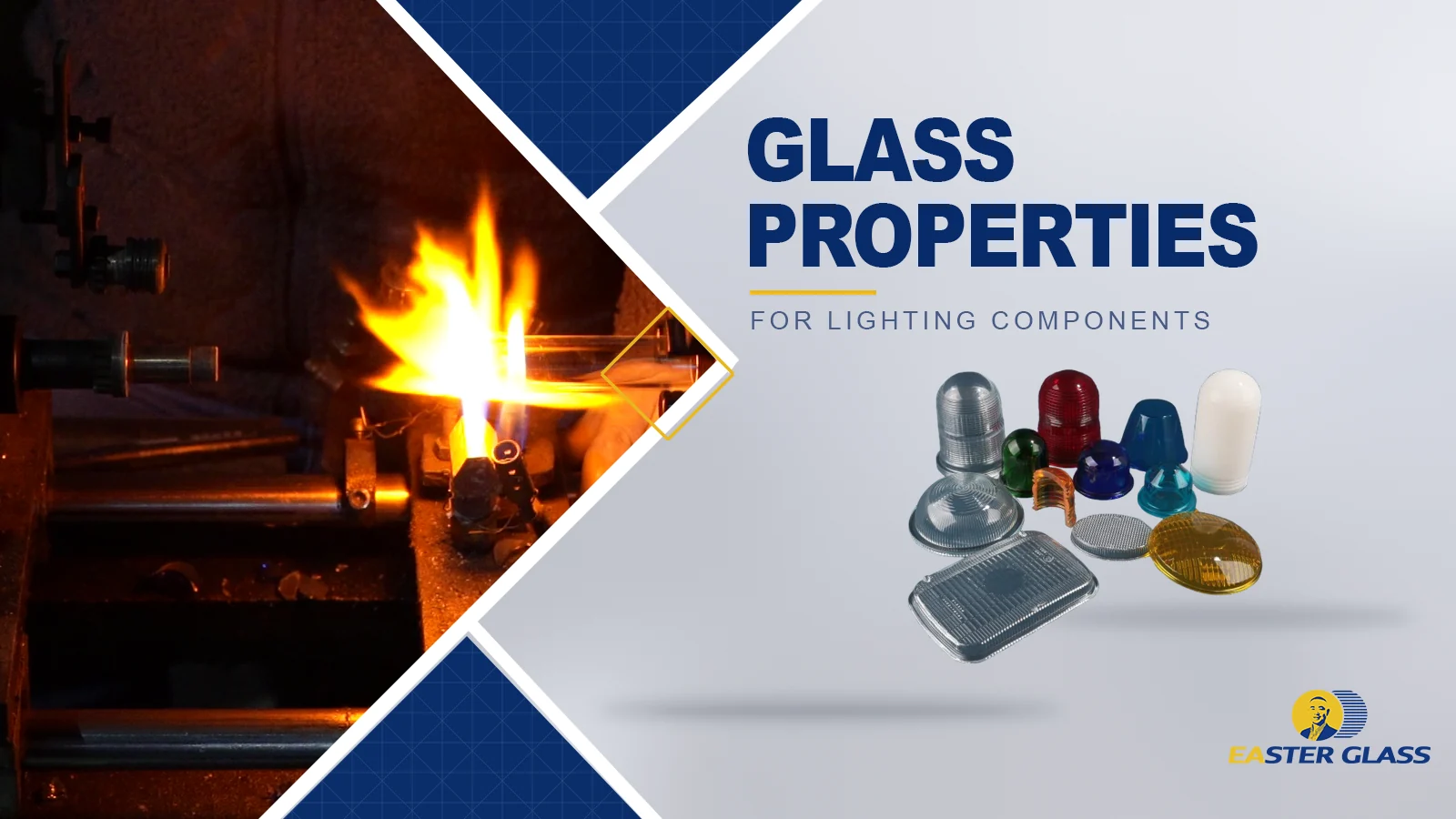
Glass material properties for lighting components fall into linked groups: structure and composition, forming response, thermal behaviour, optical interaction, chemical durability, and mechanical response. The properties that matter depend on the part’s optical function, geometry, manufacturing route, mounting, and operating environment. A useful review starts with function and ends with evidence for the specific material and part.
Why do glass properties need to be read together?
Glass is an amorphous, non-crystalline solid. The Corning Museum of Glass describes it as a material with a disordered structure; composition changes can alter characteristics such as colour, opacity, and strength. For lighting design, that broad connection is useful, but it does not let a reader infer the performance of a particular part from its family name alone. Corning Museum of Glass: What is glass?
Commercial glass is made from oxide ingredients that perform different roles in the glass network. A Lehigh University course on commercial glass compositions introduces these roles alongside families and application examples. The course is general industry teaching material; it is not a property sheet for any Easter Glass grade or a measured result for a lighting component. Lehigh University IMI-NFG, Lecture 1: Commercial glass compositions, properties and technical considerations
For a component, material properties are only one input. Shape, surface, forming history, contact points, neighbouring materials, and service conditions also matter. A value for a material specimen under stated conditions does not directly describe every response of a finished part.
A category name is not a complete specification. “Optical glass,” “borosilicate,” or “diffuser” gives broad context, but does not identify composition, grade, test conditions, or suitability for a particular luminaire.
A map of the properties that shape a lighting component
The map below is an overview. It connects each property family to a design question without assigning a universal value or repeating the detailed treatment of each property in separate technical articles. The design implications are general engineering guidance, not Easter Glass specifications.
| Property group | What it describes | Lighting design relevance | Evidence required |
|---|---|---|---|
| Structure and composition | Glass network and ingredients | Basis for other properties | Named grade and documentation |
| Viscosity and forming response | Flow and shape change with heat | Route and geometry shape forming | Material-specific process and part design |
| Thermal behaviour | Expansion and temperature response | Heating, neighbours, and mounting matter | Temperature, location, mount, and test conditions |
| Optical interaction | Refraction, transmission, absorption, colour, and scattering | Optical function differs by part | Wavelength, geometry, surface, and specified quantity |
| Chemical durability | Surface response to exposure | Cleaning and service environment matter | Agent, method, surface, and criteria |
| Mechanical response | Response to load and contact | Support and surface condition matter | Geometry, load, edge, and test method |
The table does not rank property groups. Their importance depends on the lighting function, part geometry, mounting, and exposure conditions.
Structure and composition establish the material context
Structure describes the glass network; composition describes the ingredients that build or modify it. They explain why broad family labels do not guarantee identical behaviour. This overview sets context; detailed chemistry belongs in dedicated material articles.
A family label is not a grade identification. Compare only when the named grade, glass form, source document, and method are clear. Otherwise record the uncertainty instead of borrowing a value from another material or product form.
Forming response connects the material to the part shape
Viscosity describes resistance to flow. In glass manufacturing, the way viscosity changes with temperature is relevant to forming and thermal processing, but the relevant curve belongs to a specific glass composition. A general curve or a characteristic point taken from another grade should not be treated as an Easter Glass process setting or as a guarantee that a given geometry can be made.
Shape changes the forming question. A deep cover, repeated lens features, and a thin textured region have different geometric demands; feasibility depends on geometry, tooling concept, process route, surface requirements, and the specification, not on the material name alone. This identifies review inputs, not supplier capability.
Thermal processing after forming also matters to the finished component. Annealing is a controlled cooling process used to reduce stress gradients associated with forming. The public Easter Glass article on the glass annealing process for lighting components explains the process context. Its embedded video illustrates an annealing stage; it should not be read as a property-value demonstration or as a process window for a named material.
Thermal behaviour belongs to the material and its assembly
Thermal expansion describes how a material’s dimensions change as temperature changes. In a lighting assembly, a glass component may warm unevenly or be constrained by a mount or neighbouring part. The design question is therefore not only “What is the expansion of the glass?” but also “Where is the temperature change, how is the part supported, and what can move or constrain it?”
A material-sheet value can inform an early comparison, but it does not predict finished-part stress by itself. Geometry, temperature distribution, constraints, contact, and assembly affect the result. Thermal shock and thermal stress are related but distinct; neither is captured by a broad claim of universal heat resistance.
If temperature matters, record expected operating conditions, the source of each value, adjacent materials, and the mount. Those details frame, but do not replace, a material-specific calculation or validation.
Optical interaction depends on what the part is designed to do
Optical properties describe how light interacts with the glass. Refraction changes a light ray’s direction as it enters or leaves a material; transmission describes light that passes through; absorption removes some light from the transmitted path; scattering redirects light; and colour describes the spectral appearance produced by selective absorption or other optical effects. These terms describe different phenomena and should not be treated as interchangeable. An MIT OpenCourseWare lecture on glass optical properties treats refraction and dispersion separately from absorption and scattering. A NIST overview of reflectance and transmittance measurements also shows why wavelength and measurement geometry belong in the interpretation.
A lens or prism is intended to redirect light in a controlled way. A diffuser or textured cover may be designed to redistribute light, while a clear cover may be required to protect a source with limited visual change. Those functional labels do not establish a particular transmittance curve, refractive index, beam distribution, or colour value. The specification should name the intended optical function and the measured quantity, then identify the geometry and conditions under which it will be assessed.
Optical comparison is especially sensitive to part form. A flat test coupon, a curved cover, and a patterned lens do not create the same optical path. Surface texture, curvature, thickness distribution, pattern geometry, and viewing direction can affect the observed result. A material property may be one input, but the finished component’s geometry and surface are part of the optical system.
Avoid vague terms such as “high optical quality.” Name the required outcome—transmission, refraction, colour, diffusion, glare control, or feature definition—and how it will be evaluated.
Chemical durability is an exposure question
Chemical durability describes how glass responds to chemical contact and environmental exposure. The word “resistant” is incomplete unless the substances, concentrations, contact time, temperature, cleaning method, and surface condition are defined. Water, acidic cleaners, alkaline cleaners, salts, and other environments can create different questions, so a broad family name cannot answer every service scenario.
Exposure can occur during manufacture, installation, cleaning, or service. Define the agent, duration, repetition, and any coating, print, or sealant.
Tie a durability claim to a named glass and defined condition. If the chemical or cleaning process is unknown, record it as an open input rather than inferring suitability from a family label.
Mechanical response depends on flaws, edges, and support
Mechanical response includes how a component behaves under applied loads, contact, impact, assembly forces, and restraint. Glass is not adequately described for design purposes by a strength number alone. Surface and edge condition, component geometry, loading direction, support points, and residual stress can all affect the behaviour of a finished part. An NIST review of crack growth in glass describes small cracks as a limit on glass strength and explains why stress context matters when interpreting mechanical evidence.
Edges, transitions, contact points, supports, and restraints change the load case. Handling can add forces absent from specimen testing, so a generic strength value cannot predict the finished part alone.
Residual stress is a separate but related subject. It may arise from thermal history and can influence how the component responds to later loading or temperature changes. The dedicated annealing article covers the process relationship; a separate thermal-stress discussion should be treated on its own terms. No residual-stress value or acceptance threshold is assigned here.
How do common glass families differ at an overview level?
Soda-lime-silica glass and sodium-borosilicate glass are two commercial families frequently used in general comparisons. The Lehigh University course material lists examples of uses and qualitative characteristics for these families. Those examples are educational context, not a statement about the materials used in any particular Easter Glass product. Lehigh University course slides
| Family | Examples listed in the university course material | Qualitative note in the course material | What this overview can and cannot establish |
|---|---|---|---|
| Soda-lime-silica glass | Flat glass, container glass, tableware, lamp glass, and lenses | Presented as a mass-production glass family | It is a broad family description; it does not identify a specific grade or component value |
| Sodium-borosilicate glass | Laboratory glass, cooking utensils, and headlights | Described qualitatively as thermal-shock resistant | It is a broad family description; it does not establish suitability for a given lighting assembly |
The table is qualitative. Its examples span multiple product forms and do not establish a material choice for a luminaire or an Easter Glass production capability.
Compare evidence for the actual grade and intended form. Do not transfer a value from tubing, a container, flat glass, or laboratory glass to a shaped lighting part without reviewing its method and conditions. The live borosilicate lighting glass forming and design limits article adds process context, not grade-specific values.
The public site lists Borosilicate Glass and Optical Glass collections, plus individual entries: Clear Oval Borosilicate Glass Lighting Cover, Frosted Borosilicate Glass Fresnel Lens, and Tinted Optical Glass Diffuser Disc. These live titles identify site entries and product forms; they do not provide grade-specific property evidence.
How does a material property become a finished-part response?
A material property becomes useful when it is connected to a defined component and a defined condition. The chain below separates material identity from manufacturing and assembly effects. It is a reasoning aid, not a predictive model, tolerance statement, or claim about an Easter Glass product.
First describe the part’s function: cover, lens, prism, refractor, diffuser, or decorative feature. This helps identify relevant property groups, but does not settle material selection when several requirements interact.
Then describe geometry and boundaries: key surfaces, edges, mounts, contacts, neighbouring materials, and areas of concentrated light or heat. A drawing or sample helps define the part; operating conditions define its environment.
Record the material or grade, source document, method, condition, and whether evidence is for a sample or finished part. Keep family descriptions separate from project measurements; list missing data and the review needed before release.
When a project engages a lighting glass manufacturer for property and test-method coordination, discuss grade, method, and intended part together. A lighting glass supplier for documented operating-condition review should distinguish family descriptions from evidence for stated conditions. An OEM lighting glass supplier for drawing-defined geometry review may also need the part and assembly context. These phrases describe project roles, not material claims.
Geometry-led projects may describe a custom lighting glass component mapped to a product drawing, a made-to-drawing glass part with defined optical and thermal requirements, or a prototype lighting glass development plan tied to a test method. In each case, keep the drawing, separate requirements, and validation evidence connected; no design result is implied.
What information should be attached to a property value?
A property value should carry enough context for another engineer to interpret it. At minimum, identify the property, the material or grade, the source, and the method or condition used to obtain it. Where the test specimen differs from the finished component, state that difference rather than implying that the value is a direct prediction of part behaviour.
| Information item | Question to record | Relevance |
|---|---|---|
| Material identity | Which named grade or specification? | Family labels cover different materials |
| Property definition | Which quantity and unit are reported? | Terms can describe different phenomena |
| Test method | Which measurement method was used? | Method defines comparability |
| Test condition | Which temperature, wavelength, exposure, or load applies? | Conditions set the result’s scope |
| Specimen form | Was the sample a coupon, sheet, tube, or finished part? | Form and geometry affect application |
| Part and assembly | Which geometry, surface, edge, mount, and neighbour? | Service response depends on boundaries |
| Acceptance decision | Which criterion and approver apply? | Measurement alone is not acceptance |
Before a value enters a specification, record its source and intended use. State whether it is supplier-published, independently measured, or calculated; record the material identity and specimen represented. If a document gives only a broad family summary, do not promote it to a project material requirement. Treat it as screening information and request evidence relevant to the grade under evaluation. This keeps the decision traceable when the material, forming route, or part design changes.
When a property is connected to acceptance, the drawing and quality plan should state whether the criterion applies to material, process sample, or finished component. Identify the measurement location, orientation, surface state, and responsible reviewer where these affect interpretation. A result without a defined specimen or method can be hard to compare with another result, even when both use the same property name.
Where data are missing, separate facts from assumptions. Record the open question, source needed, and decision owner; do not substitute a family-level description or a value from a different glass form. That keeps the technical review traceable and shows what evidence remains before the project can close the requirement.
Use the ASTM C162-23 standard terminology of glass and glass products as a vocabulary reference. The standard is cited by title and number only here; this article does not reproduce its definitions or clauses. A terminology reference can help teams use the same words, but it does not replace a product-specific data sheet or a test method.
Preserve provenance with a source link or document ID and state whether a value is published, measured, or calculated. If values disagree, first compare their definitions, materials, specimen forms, units, and conditions; do not average unlike results.
For optical data, state the wavelength range and whether the value applies to a specimen or assembly. For chemical, thermal, or mechanical results, specify exposure, temperature, load, support, and restraint as relevant. These prompts identify review context; they do not prescribe one universal test.
Ask a lighting glass supplier for documented operating-condition review to connect a published value to the grade and form. Keep made-to-drawing glass parts with defined optical and thermal requirements tied to the actual drawing, surfaces, and mount. The OEM/ODM page and live Quality page identify relevant site owners; they do not supply an unreported material value.
A practical review sequence for lighting teams
Start with the lighting function and translate it into property questions. A lens may raise questions about refraction, transmission, surface form, and colour; a diffuser may raise questions about scattering and appearance; a cover may also require a review of exposure, mounting, and temperature. Keep distinct functions and requirements separate so a material-family label does not stand in for evidence.
Connect each question to the part definition: geometry, edges, interfaces, patterned surfaces, mounting, neighbouring materials, and expected conditions. Then define the evidence source or method, the relevant test condition, and whether it applies to raw material, a specimen, or the finished component. Assign review responsibility, and leave unavailable data as an open requirement until it is resolved.
The sequence is useful for a lighting glass manufacturer for material evidence and part-context review because it connects the material question to the part and its evidence. For custom OEM or ODM work, the OEM/ODM project review is the relevant site entry point for drawing-led or concept-led development. The decision remains project-specific: a general reference can orient the discussion, but it cannot approve a material or finished part.
Frequently asked questions
Which properties of glass matter in a lighting component?
The relevant properties depend on the part’s optical function, material, geometry, mounting, and operating environment. Thermal, optical, chemical, mechanical, and forming-related questions may all matter, but the project should identify which ones govern the specific component.
Do all glass types have the same properties?
No. Glass composition and structure influence properties, and a broad family name does not identify a specific grade or test result. Values should be applied only when their material, method, specimen form, and conditions match the question being reviewed.
Why do composition and structure decide the properties of glass?
Glass structure and composition establish the material context from which its thermal, optical, chemical, forming, and mechanical properties arise. This overview does not assign a composition or property value to any Easter Glass material; such claims require approved, grade-specific evidence.
Where can each property be read about in detail?
Use a property-specific technical source that matches the quantity and material under review, and check the relevant standard or test method where appropriate. The Easter Glass annealing article provides process context, while the live Borosilicate Glass and Optical Glass category pages and product pages identify public site entries; none of those page labels alone supplies a complete property data set.
Technical takeaway
A glass family name is a starting point, not a complete engineering specification. Begin with the lighting function, identify the property question, match evidence to the named material and test conditions, then review the actual geometry, surface, mounting, and service environment. Keep general industry references separate from product-specific evidence and from any Easter Glass material claim.
For a drawing-led or concept-led project, use the Easter Glass OEM/ODM project page to route a technical discussion around the part definition and the evidence the project needs.
Connect the property question to the part
For a drawing-led or concept-led discussion, bring the part definition, intended operating conditions, and the property evidence the project needs.
Review OEM/ODM project options
Technical glass components for lighting applications.
Technical note: External sources in this article are general industry references. The article does not assign material composition, grade, measured property values, acceptance limits, or product-specific performance to Easter Glass.
 English